Cast-Iron Portland
 The Poppelton Building and Harker Building on First near Yamhill. I often try to re-create Portland's first downtown along the river in all its cast-iron splendor. The city's architecture, unique to the entire region in its scope and scale, was the earliest manifestation of Portland's singular essence of place outside of its natural setting. Currently the Architectural Heritage Center is providing a wonderful chance to experience Portland's emergence as a major city with Cast-Iron Portland.
The exhibit features fixtures from many of Portland's vanished architectural treasures: the Abington, Smith and Watson, Cooks and first Sherlock buildings, including a golden griffin from the Kamm Block, and an iron wolves head from the Ladd Block, which was torn down overnight in 1965 in a shameful episode after its ownership learned that the PDC recommended the building be preserved.
Cast-Iron Portland is not only a story of loss, but of revival. A slide show on a wide-screen monitor features photographs of many of Portland's surviving cast-iron buildings in dilapidated condition before restorations completed over the last forty years. The transformations are stunning and hint at what can be accomplished in the future.
The Architectural Heritage Center is open Wednesday through Saturday, 10am to 4:30pm at #701 SE Grand Avenue.
Villard's Ruins"That's one of the reasons why the streets grow duller and duller. If there is anything curious, anything beautiful in a street, they take it away and stick it in a museum." -from the short story "N" by Arthur Machen.But not everything interesting ends up in a museum. On the wall in Jake's Famous Crawfish hangs on of Portland's more historic paintings, Villard's Ruins, by Portland artist Francesca Grothjean (1865-1945).
The painting, in a Romantic style suited for crumbling antiquities, was of ruins anything but ancient.
In 1883 Portland was connected to the national rail network via Henry Villard's Northern Pacific Railroad. Villard reasoned that the terminus of a trans-continental rail line would need a first class hotel. He purchased the block bounded by 6th, 7th, Morrison and Yamhill then began work on what was anticipated to be Portland's new palatial showpiece.
The completion of the railroad had financially over extended Villard. Work stopped on the hotel after only the foundation had been completed. For six years, Villard's ruins, as they were known, lay fallow, a civic frustration (and twice a crime scene) until the project was resuscitated by Portland's usual plutocrat suspects.
The Hotel Portland would be at the center of city life until being torn down in 1951. Much of Villard's ruins still lie beneath Pioneer Courthouse Square.
 Separated by one block to the west and 126 years; the suspended Park Avenue West tower, what might be called "Moyer's ruins."Thanks to the fine folks at Jake's Famous Crawfish, who not only allowed me to photograph their painting, but even offered me a chair to stand on.
The Art of the Pass
 Portland Traction weekly pass, April 14-20, 1940.By the 1930s, Portland's transit network was in desperate need of modernization. Most of the city's streetcars had been built before World War I and were showing their age. Ridership decreased as maintenance costs rose. Fairs, constrained by franchise, were locked in place by the city. To isolate the financial loses from its electric utility corporate parent, the transit lines were re-organized, first as the Pacific Northwest Public Service Company, then as the Portland Traction Company, with little visible changes to the riding public. The once world-class system was the topic of angry newspaper editorials and the city council agenda.
  Portland Traction city lines car #439, near the east end on the Broadway Bridge on the Bridge Transfer line, so named because it connected each of the routes that crossed the downtown bridges on the east side of the river. (Click on pictures to expand).
The situation began to be addressed in 1932 with the introduction of fifteen modern streamlined streetcars. Built by Philadelphia's J.G. Brill Company, they were soon nicknamed the "Broadway cars" for their initial assignment on the line that connected northeast Portland to the premier entertainment district downtown.
 As delivered, the "Broadway cars" had gray sides with an ivory window band that was bracketed by hunter green borders, with black roofs and striping. The complex paint scheme lasted only a few years before being replaced by simplified green and cream colors, which were in turn replaced by maroon and cream in 1940. No known color photograph of the original paint scheme is known to exist.
"Three new modern cars went into service yesterday on the Broadway line and did a rushing business. It seemed that passengers wanted to try the new cars and loaded them to capacity, often allowing the old-time cars to pass by to permit them to ride the new cars." -The Oregonian, May 16 1932.
The cars were popular with the public and soon found use on many of the systems heavier trafficked lines. They did nothing however to address the problem of moribund track and infrastructure. It would not be until the 1937 adoption of electric buses, aka "trolley coaches," as told in the post Off Line Too Soon, that a turn-around of Portland's public transportation system took place.
 The "World's finest trolley system" brochure / map highlighted the "trolley coaches" (seven pictures), gasoline buses (two pictures) and modern streetcars (one picture).
  A typical weekly transit pass from the early 1930s.New equipment was not the only way to re-engage the public. Starting in the mid-1930s, Portland Traction mounted a campaign that transformed the utilitarian weekly transit pass into a colorful showcase of community life.The passes, created by anonymous graphic artists, provide a view of Portland's depression era values, pride, aspirations, hidden prejudices, current affairs and in some cases, out and out whimsy.
What follows is a small sample of the colorful stand-out design of Portland Traction's transit passes, from the middle of the Great Depression to the start of World War II -The art of the pass...
 "See Portland from the Heights." Even though the amusement park atop Council Crest had been closed for seven years, a trip to the top of the line was still viewed as worthwhile in its own right.
 The Native American themed Oregon City Territorial Days pass provides a portrayed closer in line with popular western movies than anything particularly Chinook, Molalla, Wasco, Rogue or Klamath...
 "Greater Show Season"
 "Ride the Trolley Bus- You'll Like It" advertises the downtown test loop built to gauge public acceptance of electric buses in 1935. On the flip side was a map (below).
 "Build Oregon's Payrolls" brings to mind the Forgotten Man finale in Busby Berkeley's Gold Diggers of 1933.
  "Toward a Greater Oregon."
 "During the Civil War..." is amazing for its bland, stark statement of self-evident justification, bereft of regret, apology or even euphemism. Not fighting, not removing... but exterminating.
 29th Annual Rose Festival 1937.
  Fleet Week!
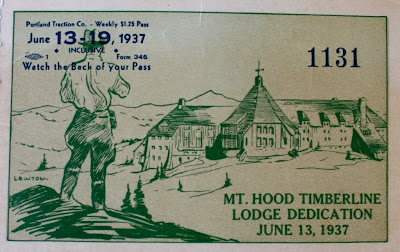 Dedication of the WPA built Timberline Lodge, June 13 1937.
 Never mind the fully developed railroad system, or flights via Aeronaves de Mexico...
 Federal Music Project.
 Save the Battleship Oregon- a successful effort, until a World War II scrap drive.
 Haystack Rock, part of the "Interesting Oregon" series of passes that features locations throughout the state.
 At least three passes features animals singing the praises of the new trolley coaches, in rhyme (!)
 Tractionetiquette- have your change ready.
 The forests are crops, the harvest is homes!
 Ride the trolley to X-Mas Land.

 An enigmatic series of numbered passes from 1940 whose significance is unknown.
 Think! Then Vote!World War II bought an end to the era of Portland Traction's colorful weekly passes as wartime austerity found a graphic equivalent.
  "...Step up...Speed up...This is War!" The front and back (below) of the January 28- February 3 1945 pass.
 The post-war era brought little in the way of improvement, other than the handy thumb guide.Passes were revived for monthly use in the Tri-Met era.
 1977's passes featured a symbol for each month, in the case of June, a rose. In hindsight, a basketball would have been more appropriate.
  The 1979 Tri-Met passes featured Portland's bridges.
Monthly passes continue to this day on Tri Met. They are colorful and functional, but have looked much the same for the last few years. In a city full of graphic designers, what might be possible? The "Broadways" on Burnside - In Color
After all but the final three streetcar lines were abandoned in 1948, the "Broadway cars" were assigned to the Twenty Third Avenue line that linked downtown with northwest Portland where they ran until the end of the original streetcar system in 1950. After abandonment two of the cars were re-gauged and transferred to the Portland to Oregon City / Bellrose interurban lines that ran until 1958. One of those cars, the #813, survives to this day and can be ridden on the Willamette Shore Trolley line between South Waterfront and Lake Oswego (service is temporally suspended due to trestle work). The #805 (in the final "tomato red" color scheme adopted after 1948) and the #804 (in post 1940 maroon and cream colors) on the Twenty Third Avenue line at Nineteenth and Burnside, circa 1949-1950. The blue-gray building to the right is now the location of a McDonalds.
 The #807 turns off of Burnside on to Washington at 15th. The brick apartment building still exists, but the Studebaker Used Car Department building is now where the off-ramp from I-405 joins Burnside.
The Rise and Fall of the Great Light Way
The 1890s were the decade of Third Street. Long the outskirts of downtown, it was now the center. Large commercial buildings in the prevailing brick and sandstone Romanesque Revival style rose up and down the thoroughfare, a linear echo of the new, post fire, Seattle. The horse-car lines of the Transcontinental Street Railway were electrified and merged into the new City and Suburban Railway Company, with Third Street as the main north / south trunk line. Retail, restaurants, finance and entertainment met and mixed in the city's new metropolitan heart.
 Washington at Third, the Dekum Building is to the left. (click on pictures to expand).
Towards the river, the old downtown was devolving into the wholesale district. To the west, large scale development was rapidly occurring, but it was less concentrated. Third Street; substantial and energetic, held the essence of Portland, described by the Reverend H.K. Hines as "so new and yet so old...
"As one steps ashore and rises into the streets, and looks up and down and out, between long rows of stores and hotels, rising for six or ten stories of massive form and splendid architecture, and sees the ceaseless stream of comers and goers, the flashing of hundreds of electric cars, and listens to the ceaseless roar of business, the illusion of the first impression vanishes and he awakens to find himself in the heart of a great commercial emporium." -from An Illustrated History of the State of Oregon by H.K. Hines (1893) as quoted in The Shaping of a City by E. Kimbark MacColl.

Third from Alder. To the left, the Dekum Building and two blocks beyond, the massive Chamber of Commerce Building. The Sherlock and Ainsworth Buildings can be seen in the distance furthest left.
By the second decade of the twentieth century, things had changed. Downtown had drifted west. The merchants on Third Street felt passed by and in danger of becoming part of the run-down workaday wholesale district to the immediate east.
The Broadway Bridge (1913) was the final straw. A new stream of streetcar, pedestrian and ever increasing auto traffic from the east side, where the majority of Portlanders now lived, flowed directly into what was becoming the new city center.
 The corner of NW Broadway and Davis. Unlike most downtown streets, Broadway arrived from the east, with the west side's Seventh Street appended to it after the opening of the Broadway Bridge in 1913. The City Council then wanted to change the name of eastern portion to "East Broadway" a wildly unpopular idea with the east siders. Organized as the North East Side Improvement Association, they successfully fought to keep the name.
The corner of Broadway and Davis was in the commercial strip of the first African American neighborhood in Portland. The Golden West Hotel, one block away on Broadway and Everett accommodated African American workers from nearby Union Station when many, if not most, Portland Hotels would not. It is an existing reminder of that neighborhood.
The N in the mosaic indicates north of Burnside (pre-1933 re-numbering which created the NW, SW, NE, SE and N designations). South of Burnside, Broadway would develop into Portland's cinema and theater entertainment district.
To arrest their perceived decline, merchants on Third Street came up with an audacious plan: bathe Third Street in light by building a line of illuminated arches stretching from Yamhill to Burnside (later extended on both ends to Madison and Glisan) to be known as "The Great Light Way." To supporters, organized at the "Third Streeters," the arches would cap a protracted campaign establish the thoroughfare as the center of Portland night-life and attract more business to the area, especially, it was hoped, large movie theaters.

The double-arched fixtures rested on four concrete encased Doric columns to straddle each intersection. Both linked arches had ninety-six 40 watt "lamps" with more clustered at the column's capitals. The arches were topped by a 750 watt nitrogen bulb. Power was provided by the Northwestern Electric Company for $6,700 a year.
As the arches went up, anticipation grew for the gala to accompany the lighting ceremony, which was scheduled for June 6 1914. Large banners were hung, thousands of promotional buttons manufactured and advertisements placed in the newspapers. A clown, mounted on horseback, rode up and down the street for days heralding the approaching celebration.
 A Third Streeters Great Light Way button.
 Oregonian Advertisement, June 6 1914.
"The band will play rag-time music and latch strings are to be open for a "big tall time" of it." -The Oregonian, June 4 1914.
"As the clock in the Journal Tower begins to strike 8, Third Street will officially begin a new life. It will have its renaissance, its rejuvenation, its refloresence and its rejuvenscence." -A quote from the Oregon Daily Journal from June 5 1914 strikes into new linguistic territory.
 At eight in the evening, June 6 1915 a switch was flicked in the Northwestern Electric central powerhouse. Suddenly Third Street was ablaze in light, much to the joy of the assembled thousands celebrating up and down its length. Music, provided by Brown's Band and the Campbell's American Band, played until 10:30 but the party continued late into the night, to the dismay of police who would try to disperse it.
 It was a public relations coup. Optimism abounded with Third Streets prospects. It was the place where "anyone can obtain everything needed for human necessity, comfort or happiness" (the Portland Telegram). There was talk of a group of San Francisco capitalists that were considering building a large motion picture theater with a capacity of two thousand seats on Third Street, a very welcome development.
 The arches and the accompanying event were deemed such a success that the question was asked:
"Is Third Street to have all the glory?" -The Portland Telegram.
"One is moved to ask, why should this moment of rejuvenation stop with Third Street? If we can be brilliant in one spot, why not many?" -The Portland Telegram editorial page.
The merchants on Fourth Street hoped they had the answer. A new system of lights, bracketed on to buildings from Yamhill to Burnside was proposed to, and then approved by the City Council.
"The lights are to be different than any in this city. The business men plan to outdo Third Street." -The Portland Telegram, October 1 1914.
It is not likely that the bracket lights on Fourth Street were ever installed. Perhaps the idea lost momentum in the ramp up to World War I. Whatever the case, Third Street was not outdone by them.
It would be up to Third Street's old nemesis, Broadway, to light the next salvo...
"Shine up your shoes, send your Sunday suit to the cleaners, go pick out a new tie and make a date with your best girl. Go have your hair marcelled, your fingernails manicured, get a new lip stick and a box of rouge and put that lonesome note in your voice when your steady calls you on the telephone. Tuesday night the new Broadway lights will be turned on for the first time and carnival will reign." -The Sunday Morning Oregonian, November 22 1925.
 Pantages Theatre, on Broadway and Alder, circa 1918. Not the old-style globe streetlights.
By the mid 1920s Broadway had established itself as Portland's theater and entertainment hub. As such, it was deemed perfect for the next of what was then being referred to as ornamental lighting districts. The Broadway Association approved the placement of new lighting from Hoyt south to Jefferson at the cost of $120,000.
The new lights featured a twenty foot pole that supported two 15,000 lumen incandescent lamps in urn shaped alabaster globes, topped glass canopies that diffused light upwards to illuminate surrounding buildings.
"From the standpoint of illumination per square foot, the Broadway association announces, Broadway will be the best lighted street in the world. Main Street in Salt Lake is the second, the "Path of Gold" in San Fransisco third, and Broadway in Los Angeles fourth." The Sunday Oregonian, November 22 1925.
"Gay with iridescent brilliance of the Milky Way, the main boulevard of the City of Roses will burst Tuesday evening into a dazzling orgy of electric rays that will rival the most famous glittering thoroughfares in the world." -The Portland News, November 24 1925.
 The lights of Broadway.
On the evening of November 24 1925, thousands gathered on Broadway in anticipation of the lighting ceremony. Businesses hand been encouraged to keep every light on and red flares lit the center of the street. At 7:30 from a platform built in front of the United States National Bank, Mayor George Baker, in his favorite roll as civic ringmaster, gave the introductory speech. Then, at 7:40, the President of the Broadway Association pressed a button and lit the street. A roar went up from the crowd. Atop the Liberty Theater a siren wailed -the signal to all the ships and boats on the Willamette to blow their whistles and horns simultaneously in eight long blasts; one for each letter of the word Broadway.
Then a parade began, lead by Santa Clause with a pre-Rudolph retinue of six reindeer. It was followed by a night of dancing, with radio music blaring from each intersection and the Elks Band playing until one in the morning.
"Indeed, many visitors from New York have declared Portland's Broadway to be better lit than New York's." -Forbes Magazine, September 21 1926.
 The Scott Hotel and the Broadway Cafeteria on the south east corner of Broadway and Burnside, with the new Broadway lighting and an early traffic signal. The block today, across from Mary's Club, is vacant. -Portland City Archives.Over the next few years more ornamental lighting districts followed: Grand, Washington, and Jersey Street in St. Johns, each with celebrations of decreasing intensity.
"In January 1927 Fifth and Sixth Streets and the U.S. Grant Park systems went into effect by automatic control without speeches, bands or dancing. Ornamental lighting had become routine. " -from A History of Street Lighting in Portland, Oregon by Catherine Sohm.
 View from under the arches: The Boston Packing Company at the north-west corner of Third and Ash. The building was replaced by a service station in the 1930s that still exists as an office for J.T. Atwood. The Zellerbach Paper Company building in the distance is at the site of the present day US Bank Tower, aka Big Pink. The arches at Third and Ash are visible, one block to the north. -Portland City Archives.
On Third Street the arches stayed lit. They had not stopped the westward advance of downtown, but were regarded by the Third Street merchants as having allowed them to hold their own. The hoped for two-thousand seat movie theater never arrived, but the building of the Portland Municipal Auditorium (today, much remodeled, the Keller Auditorium) on Third between Market and Clay was attributed to the efforts of the Third Streeters.
"Considered merely as an advertisement, such projects are worth all their cost and upkeep." -Third Street merchant Ira F. Powers in Forbes Magazine's September 1 1926 article: The Street that Held its Own by Better Lighting.
 Under the arches: The Union Cafe on the north east corner of Third and Ankeny. Today the building houses Berbati's Pan and Voodoo Donuts. -Portland City Archives.
The arches north of Burnside were removed during a 1920s street widening projects. The rest remained lit until 1937, when, due to the Depression and electric company franchise changes, the power was cut and the arches removed. Three survived until August 1940, when they were ordered down by the City Council.
Nearly a year later, on June 8 1941, a new organization, the Third Avenue Better Business Association, announced that it sought a revival of Third (by then) Avenue. Modernization of office buildings, new store fronts, better street lighting and eight new surface lots with free parking were offered to the public as enticements to bring business back.
In 1958, the City Council abolished all ornamental lighting districts, folding them into the existent city lighting program.
"You will find the crowds not on the dingy, dark ill-lighted streets, but rather on those thoroughfares that shine out with a blaze of color and brilliance." -Third Street merchant Ira F. Powers in Forbes Magazine, September 1 1926.
The fixtures on Broadway remain hidden in plain sight, the light-posts adopted as "standards" and used, with slight variations, all over downtown. The lighting system, and its luminescence, however are very different to that of the 1920s.
"Portland is know from coast to coast as one of the best lighted cities in the country." -Forbes Magazine, September 1 1926.
 Broadway in the 1960s.
 The Poppelton Building and Harker Building on First near Yamhill.


