Wednesday, June 30, 2010


A Summer Extravaganza


The 1912 Rose Festival began an extended celebratory season that reached its zenith in July, when two national delegations and thousands of revelers converged upon Portland. For seven days downtown was transformed, ablaze in light, with all the epic spectacle and impermanence of a Cecil B. DeMille studio back lot.


The Benevolent and Protective Order of Elks had selected Portland as the site of their national convention, their "Grand Reunion." The city responded with the largest civic extravaganza since the Lewis and Clark Exposition of 1905, a massive display of pageantry that reflected the importance of the fraternal order in the life of the city.


"Remember the Dates," the Rose Festival and the Grand Reunion.


The Elks Building on the north east corner of 7th (later Broadway) and Stark. Today the corner is home to the United States National Bank building which was constructed in two sections, the first, that faces 6th, in 1917 and the second, that faces Broadway, (which necessitated the demolition of the Elks Building) in 1923.


"THOUSANDS IN CITY
Railroads Report Between 85 and 100 Extra Trains"

-The Morning Oregonian, July 8 1912.


Representatives from the country's 1,260 lodges arrived by the trainload at Union Station. The delegates, collectively referred to as "Bill" were greeted by their Portland hosts. Accompanied by bands playing and the singing of the song Hello Bill, they were paraded to their designated hotels. One hundred thirty five men and women from Sacramento alone were billeted at the Portland Hotel. Seventy five attendees from Chicago were based in the Imperial. At the Multnomah Hotel, the thunderous entrance of the delegation from LaGrande was said to have rattled the chandeliers. The arrivals were so frequent that the processions up 6th street were practically nonstop.


The Elks were not the only visitors. Into the maelstrom of riotous bonhomie arrived yet another cohort of true believers: the suffragettes. Hundreds of eastern delegates from the General Federation of Woman's Clubs convention held in San Francisco were returning home. At Union Station their special train was greeted by large crowds of Portland supporters who escorted them to the Multnomah Hotel for a week long stay in support of the Oregon campaign for Votes for Women.


The Multnomah Hotel (today known as the Embassy Suites) which hosted both the suffragette delegation and the chandelier shaking Elks from LaGrande.


The next arrivals came by sea. The battleship USS Oregon, still decades away from its role as a Portland waterfront museum piece, arrived with its attendant flotilla to its own boisterous welcome.


On the first day alone of its visit to Portland, five thousand visitors were ferried mid river to the battleship Oregon.


Conventioneers, sailors, suffragettes and locals swarmed the city with crisscrossing synergy. The same decorated interurban cars of the Portland Railway Light and Power Company rushed the suffragettes to the Chautauqua Grounds in Milwaukie and the Elks to a truly gigantic barbecue at Oaks Park that was attended by 20,000. At the Taylor Street Methodist Church, young women chalked murals on the sidewalk to promote the suffragette cause to the morning crowds. Hotels, bars, restaurants and department stores hosted record crowds. Breweries ramped up production with special brews. The sailors did what the sailors do.


The giant onion dome of the Chautauqua Auditorium in Milwaukie hosted many suffragette activities during the week. Built in 1895, near the interurban line to Oregon City, it could hold three thousand people.


The Taylor Street Methodist Church on the south east corner of Third and Taylor. Prominent suffragette Frances Squire Potter addressed a large audience there Friday, July 12 1912. Young women spent the early hours of the morning chalking murals on the sidewalk in front of the church to draw attention to the issues and Potter's speech.


An Oregonian advertisement for the Star Brewery's Hop Gold Beer, aimed at the Elks, aka "Bill." (click on images to expand).


Convention week, looking west from the corner of Third and Morrison. Three blocks to the right towers the doomed Marquam Grand, four months prior to the collapse of its east side on November 21 1912. Extensive as they were, the street decorations paled in comparison to those further up town.


At the center of everything was the Court of Honor, which enclosed four blocks, on 6th, 7th, Yamhill and Stark streets with rows of pillars topped with globes and strung with white and purple lights. At each corner it was bounded by large white arches.


The south east corner of the Court of Honor, looking north on 6th Street at Yamhill. The Portland Hotel is to the left. The Pioneer Post Office (Courthouse) is to the far right. The gate at Stark street four blocks away can be seen in the distance.


"This is a sample of the electric decorations- there are block after block of. It is beautiful at night."
-a hand written message on the back of the post card above.


The major buildings within and surrounding the Court of Honor were decorated with thousands of lights. The courtyard of the Portland Hotel featured "an immense circle of electric globe lights" that extended to the top of the building. The Wells Fargo building boasted a lit clock face, 72 feet in diameter, with the hands set at eleven o'clock, the hour of Elk's remembrance. The Yeon Building was bathed in purple light on its lower floors, white on the upper floors and "Hello Bill" lit from the roof. The Multnomah, Perkins and Imperial Hotels and the Lewis, Chamber of Commerce and Electric buildings were all noted for the lavishness of their decorations.


The Journal Building, aka Jackson Tower and the south west corner of the Court of Honor at Seventh and Yamhill.


The Elks Building at the northwest corner of the Court of Honor, Seventh and Stark streets.


"The Elk's Lodge machinery grinds on." Committees met, elections were held. The true order of business though was revelry and pageantry as represented by processions and parades, small and large, impromptu and formal. Theater owner, impresario and future Portland mayor George Baker, true to his propensity to join everything, was a high ranking local Elk. He was put in charge of the two epic productions that capped the convention week.

The first was a "electrical parade" that featured 18 illuminated floats (likely built from old streetcars and operated on tracks) held Wednesday evening and said to have been viewed by 250,000.

It was followed on Friday by the Grand Review: ten thousand marching Elks and 28 bands on a five mile route that straddled both sides of the river and was viewed by 300,000 spectators.


"Under Fairest Skies 300,000 Turn Out as Fitting Climax to Close of Lodge Reunion - Eastern Members Amazed at Scene." -The Oregonian


The Grand Review marches down the Court of Honor.


Sailors from USS Oregon with a large (and accurate model) of their ship in the Grand Review.


(Winged ?!) Elks in the Grand Review. The building from where this picture was taken still exists. Borrowing a page from Dan Davis and his excellent Vintage Portland site, can anyone comment on where the location is? The next post will have the answer, and a current picture of the same place.


At the week's end the conventioneers, the visiting suffragettes and the sailors were departing with memories of a boisterous, frenzied, enchanted city.

To Portlanders the experience was more ephemeral; the decorations came down, a new work week began. Soon there was not a trace of the luminous spectacle.

Still, it was not likely soon forgotten. It is hard to imagine that is was not somewhat on the minds of those who conceived of "The Great Light Way" on Third street less than two years later.


Tuesday, May 04, 2010


Ducking the Questions


It might be hard to get worked up about preserving the Kiernan Building (1916), aka the Dirty Duck, when a treasure such as the Morris Marks House dire status is still unresolved. But if only masterpieces are saved, what remains is history skewed away from everyday life.

The Kiernan Building, on the corner of NW Third and Glisan, was recently approved for demolition by the city council to accommodate a new three to for story for the Blanchet House. The building is listed on the National Register of Historic Palaces as a contributing structure in the New Chinatown / Japantown Historic District, but it is part of a street scape whose history reveals a complexity beyond the simplification of Portland's "town" designations.

The areas proximity to Union Station made it an early gateway to downtown for travelers. Industry and labor, to and from the forests and docks followed as did Japanese American merchants and later Chinese Americans displaced from Portland's original Chinatown along Second. During World War II African American shipyard workers lived at the Royal Palm Hotel on Third and Flanders. The Blanchet House and the Union Gospel Mission (in the former New Grand Central Hotel) established a decades long tradition of benevolence which continues to this day.


The Royal Palm Hotel on Third and Flanders.


"History is inseparable from place. Its a complicated world, but when defined plainly, place is the stuff of memories, or all the sensory delights and fears connected to particular locations in time." -Matthew Klingle, from Emerald City, an Environmental History of Seattle.


When completed in 1916, the Kiernan Building was a typical light industrial structure. It housed Roy Chekezoff & Sons Confectionery and the Western Machine Works as well as two small store fronts. Other business followed, such as Portland Welder's Supply and the Western Union Telegraph Company.


Block #25 in 1950. The Kiernan Building, at the top right, houses Western Union, a machine shop and restaurant. Next door is a tent factory, Pike Tent and Awning. Note the Shasta Hotel on Glisan (now a vacant lot) whose name hearkens back to Portland being the furthest point north on the Southern Pacific's Shasta Route mainline. The Blanchet house (currently standing) is next door on the corner of 4th and Glisan.


The Dirty Duck Tavern was established in 1979. In 1984 it was purchased by Gail Kennedy and opened to the Gay Community, with mayoral candidate Bud Clark as a guest bartender. Kennedy's grandmother, Erma Anderson, had ran Dinty Moore's, an early Portland gay bar in the 1950s, followed by Mama Bernice's in the 1960s and the Other Inn in the 1970s. It its twenty five years of operation, the Dirty Duck was a fundraising stalwart against the AIDS crises. When it lost its lease in 2009, the Dirty Duck was the longest lived gay bar in Portland in a single location.

Also in the mid-1980s, in the space next door, Greg Sage, leader of Portland's great punk / post-punk band The Wipers built a recording studio where the albums such as Land of the Lost and Straight Ahead were recorded.

When the Kiernan Building is demolished, more than bricks and mortar is being removed.


The Kiernan Building with the Dirty Duck and Pike Tent and Awning in October 1980. Pike Tent and Awning, an example of very early construction on Third, lasted into the mid 1980s. Photo courtesy of Thomas Robinson, Historic Photo Archive.


"We are not removing something significant; removing the blight would be quite helpful." -Architect Joe Pinzone, who is designing the new Blanchet House to be built on the site of the Kiernan Building. The Oregonian, February 4 2010.


The 4 to 1 city council vote (Amanda Fritz, the sole vote against demolition) opens up a number of questions:


What does it say about Portland's green commitment when the surface parking lot next to the Kiernan Building, on long term lease to the city, remains a surface parking lot instead of a site for the new Blanchet House?


Could the Kiernan Building had at least been partially incorporated into the new development?

What will be the effect on Portland's historic fabric, now that the precedent of demolishing contributing structures in historic districts is established?

Is Portland so smitten with LEED ratings and new construction as to overlook the value of the embodied energy (the energy and materials used to extract, transport and build) in pre-existing structures?

For all our talk of sustainability, does Portland like to wear green only when it is sexy?


I'll be hosting a history talk at McMenamins Edgfield for the Oregon Encyclopedia on Tuesday May 25, at the Power Station Theater, at 6:30, all ages welcome. The topic is "The Third Streeters and the Great Light Way" a version of the program I did in October for the Architectural Heritage Center. It is the story of downtown Portland's move west, with lots of pictures.


The Wipers, Land of the Lost, recorded in the Kiernan Building in 1986.


Sunday, April 18, 2010


Relics, found and otherwise (Part 1)


On NW First Avenue, between Couch and Davis near the old Import Plaza Building sits a shin level mystery.


It is too low to work as a bench, too high to be part of the planter that borders it. The inscription: GRAND-CENTRAL, suggests a railroad station.

This in a way is correct. The New Grand Central was a hotel that once towered over Third and Flanders, near Union Station. The sandstone piece is one of a surprising number of Portland relics hidden in plain sight.


Click on pictures to expand. Photo courtesy of the Architectural Heritage Center.


When completed in 1892 by beer mogul Henry Weinhard, the New Grand Central Hotel, on the corner of 3rd and F street, was ideally situated for arrivals from Portland's still under construction Grand Central Passenger Station (Union Station was more a descriptive term than a proper name at the time) and the steamship docks on the Willamette River. The area was a gateway to Portland for travelers, where City and Suburban Railway streetcars descended from the original Steel Bridge into the evolving hotel district to continue downtown on Third Street.


The five story building was designed by architect Henry Hefty (see Peripheral Explorations) in the prevailing Romanesque revival style. It featured a decorative tower and all the modern accouterments of the day.

"The New Grand Central contains 142 handsomely furnished rooms, a well furnished office, an attractive dinning room, bar and barber shop, electric lights and elevator. Artesian water and steam heat are supplied throughout the house."
-The Oregonian's Handbook of the Pacific Northwest, published in 1894.


Looking east on Flanders, towards the new Steel Bridge, post-1915 with an arch from "The Great Light Way" over the intersection at Third. The Royal Palm Hotel in the foreground still exists.


Nearly a quarter century later, by 1915, Portland's luxury hotels were concentrated downtown, while hotels near Union Station, such as the New Grand Central, Hoyt, Royal Palm, Del-Mae-Joe and the Golden West
(the only hotel in Portland open to African Americans) catered to travelers of more modest means.

Downtown was moving west, away from its 1890s center on Third Street. In response, the street's merchants banded together to create "The Great Light Way" of lit arches on Third from Glisan to Yamhill, to provide an attraction to arrest downtown's drift.

North of Burnside, Portland's Japantown, or Nihonmachi, had coalesced between NW Second and Fifth streets. Japanese American businessman T. Yuasa leased the New Grand Central from the Weinhard estate, renovated it and renamed it the American Hotel.

Hotel operation was an attractive business for Japanese immigrants as it provided both a livelihood and a place for their families 30 Japanese American hostelries north of Burnside.


"Building leased for a term of years by T. Yuasa: Since the installation of the arches at the intersection of the streets on Third Street, a rejuvenation of this thoroughfare is indicated by the lease of the five story building. ...It has heretofore been known as the New Grand Central Hotel. The building was constructed in 1892 and is one of the landmarks of that section of Portland. It is held that this marks the beginning of a new era for this particular section of Third." -The Oregonian, June 1915.


Japanese born immigrants (Issei) were barred from owning real estate. To operate a hotel, they either had to purchase it in the name of one of the U.S. born children, or lease, as T. Yuasa did. Although the opening of Yuasa's establishment was written up by the Oregonian as evidence of revitalization along "The Great Light Way," the public face of the hotel was that of clerk W.H. O'Donald in this advertisement from the Portland City Directory of 1915.


A 1948 view looking north on Third with a flood detoured Mt. Tabor streetcar and the American Hotel. The wooden building is shown in the 1889 Sanborn Insurance atlas as the St. Lawrence Hotel. Photo courtesy of Sheldon Perry.


The American Hotel's proprietors changed frequently throughout the 1920, before settling on Joseph Grimm, who operated it from 1935 to 1950. During World War II, the neighboring Royal Palm Hotel was opened to African American shipyard workers as wartime housing. It is not known if the American Hotel was utilized likewise.


By the time this photograph was taken in the early 1970s, the building's tower had long been removed. -Courtesy of the Architectural Heritage Center.


In 1950 the building was sold to the Union Gospel Mission who operated it as their Friendly Home until 1973. It then sat largely vacant until being demolished in 1978.


Undated newspaper clipping from the Multnomah County Library's collection, circa mid 1970s.

The story would usually end there. Another part of old Portland, gone, without a trace.

However, three decorative fixtures, including the Grand Central sandstone block survived, along with a small segment of wall that bordered the parking lot that replaced the building. The pieces were acquired by the Portland Friends of Cast-Iron group, who were repatriating cast-iron remnants throughout the Skidmore Oldtown and Yamhill Historic Districts. They came to the attention of Bill Naito who was pursuing his vision of a revitalized Old town that built upon the areas history.

Bill Naito obtained the three fragments for use as decorative elements in the neighborhood. The Grand Central sandstone blocks he placed on the lot of his Import Plaza store, at the north east corner of First and Couch.


It is not known if Bill Naito's interest in the pieces was just for their age, or if he knew of the old hotel's association with Portland's Japantown. A comparison of the Grand Central blocks with his sign on the Import Plaza building suggests that it might have had some extra meaning for him.


The other two pieces from the New Grand Central were placed in a nearby alley of Couch, between First and Second, where they can be accessed through Floyd's Coffee Shop.

The remaining wall segment of the old hotel was finally demolished in the late 1990s for the construction of the Classical Chinese (now Lan Su) Garden.

(Part 2 of Relics, found and otherwise to follow).

Thanks to Portland's own Architectural Heritage Center for use of the color photographs of the New Grand Central building, Brandon Spencer-Hartle for
pointing out the sandstone blocks to me, and Bill Hawkins for telling me how they got there.


Updates, Log jams, Good and Bad News...


First the bad news. The theme of this article is relics that are hidden in plain sight (and some, surprisingly absent). Sadly the New Grand Central sandstone blocks were not hidden enough. During the time spent researching this post it was vandalized - pushed over, and now is in three, instead of two pieces. The damage is largely to hits patina, nothing another ten years of moss will not cure. The break is clean and seamless. The fact that it is face down probably protects it from further attention. It needs help and protection. Perhaps a better spot for it is in the safely locked courtyard / alley that holds its former companions.

I am happy to be a clearinghouse for information, ideas and concerns regarding efforts to restore and protect the pieces. My email address is my first initial, d followed by my last name (see profile) @comcast.net.


This post was too long coming. It kept growing, both the main article and smaller related pieces. I decided the best thing to do was to break it up. Part 2 will follow but I can not guarantee it will be the next one, as other posts line up at the gate. I think a course change is in order, with smaller, more frequent posts to gain prominence. Watch this space.

The good news: It looks like the David Campbell Memorial (previous post) is safe, at least from being parted out. It to has been recently vandalized (tagged) but has been repaired.


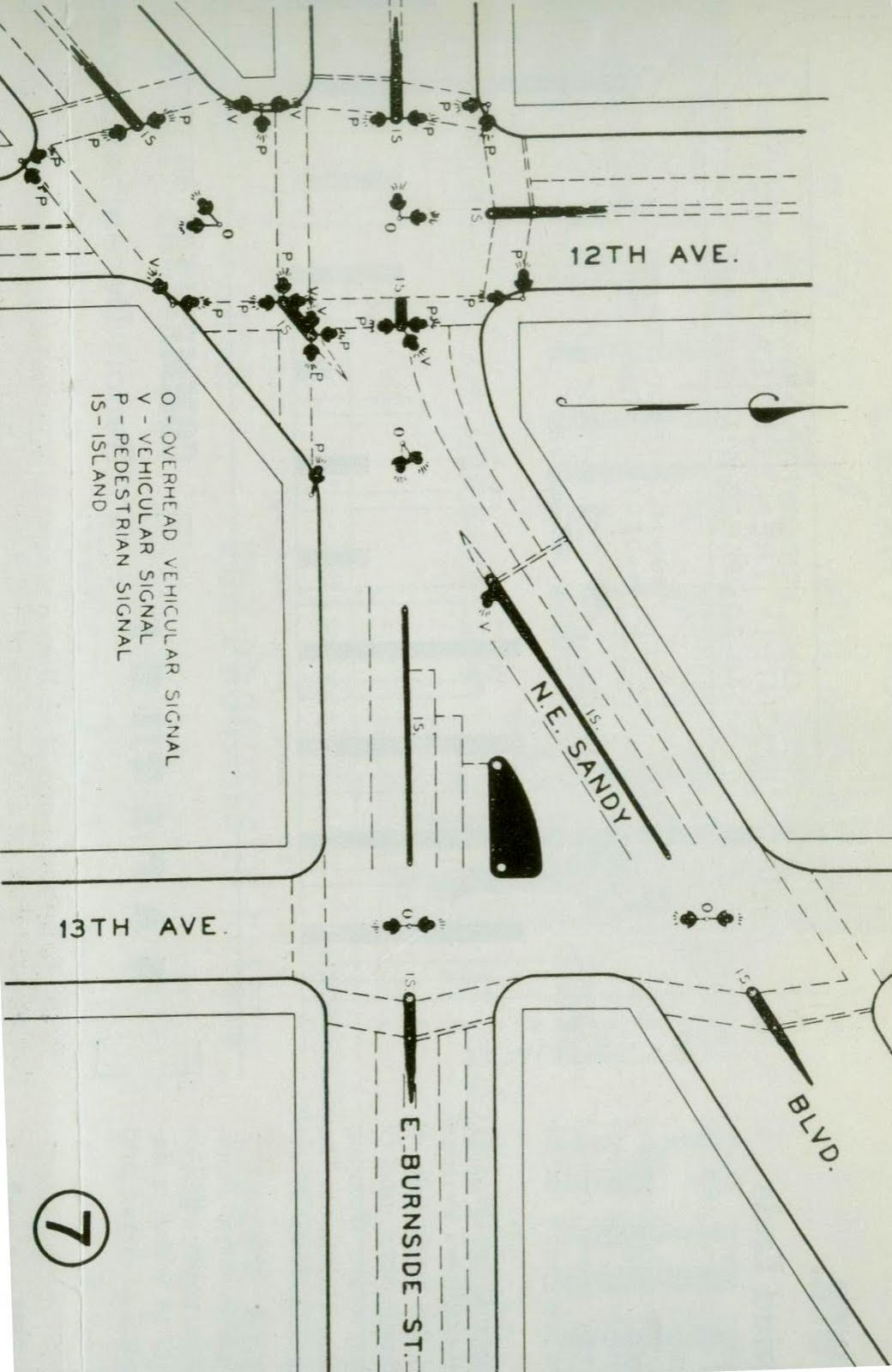
Finally, recently I showed up on KATU Channel 2 news to talk about the late "intersection from hell" at Sandy, Burnside and 12th. KATU has an article and clip here.


Sunday, January 31, 2010


Two Fountains


It is our lot, those of us who care about conserving Portland's treasures, to play defense.


The Shemanski Fountain, built in 1926, a gift from Joseph Shemanski, a Polish immigrant, to the city that showed him kindness.


On the night of April 25 2007 vandals attempted to steal the statue,
Rebecca at the Well, within the Shemanski Fountain in the Park Blocks. The statue's base held, but the fountain was heavily damaged. Months of restoration work followed. Since being repaired the fountain was damaged again, this time by metal thieves looking to cash in from selling its fixtures. Today it bears the marks of recent tagging.


The incidents highlight the disturbing vulnerability of our public heritage resources to those tone-deaf to anything but their own impulses. Possible solutions, barriers or relocation are unacceptable; to protect Portland's communal historic places from vandals and thieves can present challenges to their very nature as shared space.

To protect them from Portland's government might be harder still.


At the intersection of SW 18th and Burnside in Portland Firefighter's Park is another fountain, the David Campbell Memorial, which faces threats even more immediate and dire than those pitted against the Shemanski Fountain.


The Union Oil fire, June 26 1911. -From Portland Fire and Rescue by Brian K. Johnson and Don Porth, Arcadia Publishing.


On June 26, 1911, Portland's Fire Chief, David Campbell was directing the response to a massive fire at the Union Oil Company on the southeast corner of Water and Salmon in south east Portland. The fire, fed by abundant fuel, was so large that it attracted crowds to the area estimated by the Oregonian at ten thousand. As the structure weakened, retreat was called. David Campbell entered the building to make sure there were no longer firefighters within. A huge explosion brought the wall down that killed him.


The corner of SE Water and Salmon, January 2010, home of Pratt and Larson's tiles seconds room. The building was constructed nine years after the Union Oil fire.


Portland's fire chief for eighteen years, David Campbell was a beloved local figure whose firefighting career spanned back to the days of the volunteer fire department prior to 1883. As chief, he was an innovator who introduced motorized vehicles and fire boats to the department. His funeral procession, witnessed by 150,000 people, was likely the city's largest outpouring of public grief.


"I loved Chief Campbell and I want everyone to know how good he was. He always had a smile and a kind word for all the school children. Whenever we were late he used to take us up to school in his auto just a-whizzing, and at noon we used to hurry back from lunch and he would let us ride with him. I think he was the best fire chief that ever lived. I want to be good to the children when I get big, like he was."
-Maurice Johnson, ten years old from the Rose City Park neighborhood, in the Oregonian, June 27 1911 (from a hand written note that he delivered to the Oregonian office).


Portland Fire Chief David Campbell.
-From Portland Fire and Rescue by Brian K. Johnson and Don Porth, Arcadia Publishing.


The David Campbell Memorial and Medal Fund was established on June 21 1913 to commemorate David Campbell and all Portland Firefighters who lost their lives in the line of duty to follow. Land at 18th and Burnside was donated to the city by Katherine A. Daley in 1918.

The memorial was designed by architect Paul Cret of Philadelphia, whose career would include the Folger Shakespeare Library in Washington DC, the Main Building of the University of Texas at Austin and the Cincinnati Union Terminal. Constructed from Caen limestone imported from France, it was dedicated by Mayor George Baker on June 27 1928.


The grounds bordering the memorial were expanded to create Portland Firefighter's Park in 1964, which includes a list of thirty two Portland firefighters that lost their lives in the line of duty and an alarm bell dating from the year after the great Portland fire of 1873.


Below; drawings by Paul Cret for the David Campbell Memorial from Philadelphia Architects and Buildings:


January 2010.


January 2010.


A proposal for a new fire fighters memorial to be built near the east side of the Hawthorne Bridge has been announced, supported by Commissioner Randy Leonard. Three finalists are being considered with hopes of a dedication on June 26 2011, the hundred year anniversary of David Campbell's death. The goal of the David Campbell Memorial Association is to provide a larger more accessible memorial to Portland's fallen firefighters.

It would be hard to harbor reservations against the well intentioned project were it not for the fact that it entails the destruction of the original memorial. Plans include the removal of the bronze plaque and at least one lantern to incorporate them into the new structure. To cannibalize a historic civic space to build a new memorial shows an almost inconceivable degree of disregard for Portland's shared heritage.


Commissioner Randy Leonard in the January 21 2010 Oregonian provided justification stating:

"It's a memorial, unfortunately that time will disintegrate."

Which is true - in so much as the same thing could be said about nearly everything.

The sentiment is echoed on the Portland Firefighters Memorial website:


"Sadly, the 81 year old memorial is crumbling and beyond repair, experts predict that it will not withstand many more winters."

Which stretches the definition of beyond repair well past the breaking point.


"...crumbling and beyond repair..."


Despite a very limited public process, word of the plan to demolish the original memorial is spreading and efforts to preserve it are starting to coalesce. A facebook page, a petition, testimony at city hall and numerous articles seek a larger airing of the issue.

The question is not if Portland's firefighters deserve a larger, more accessible memorial. They most certainly do. But does it have to come at the cost of the first one, with its own intrinsic value in addition to what it represents? Is Portland large enough for two memorials or so small as there can only be one?


It is hard to imagine that the David Campbell Memorial with be defaced or demolished by the city of Portland. It should be regarded as sacrosanct -because it is. A middle course, the transfer of the bell and plaques outside of the original memorial, is easy to envision, as is the possibility more thoughtful heads prevailing.

If not, it will be time for those who care about Portland's shared, historic resources to rally and walk the talk. It is, after all, our lot to play defense.

In the meanwhile, check out the links below, visit the memorial and assess for yourself the dire claims of its condition. More important, appreciate it for what it is; it might not be there long, and for what it means.


Please join the facebook page.

You tube Video of Paul Crett's work.

On line petition

The Ellen Phillips Samuel Memorial, also designed by Paul Crett, restoration.


18th and Burnside, circa 1949.


18th and Burnside, January 2010.


-Thanks to Jon Gustafson for sounding the alarm and Tanya Lyn March for keeping it ringing.


...and a Castle


In the limited public process regarding the David Campbell Memorial, one can hear an echo of Commissioner Ormond Bean's unilateral decision in 1964 to knock down the Owl Castle in Washington Park.


The Owl Castle was built in 1894 in what was then City Park to house eaglets and owls as part of the city's nascent zoo. By 1964 its actual purpose was long forgotten. It had become a folly, along the lines of those still existent on the north side of Stanley Park in Vancouver BC. While it paled in significance to the David Campbell Memorial, it was not without charm and its demolition was meant with shock and sadness.


"Its gone. That's what happened to the city's mystery castle, the small stone fortress that used to grace the lower reaches of Washington Park." -The Oregon Journal, July 9 1964.


The site of the Owl Castle is across the road from the fountain, between the two trees. A few feet beyond the crosswalk, a second trail intersects from the right, at what was the west end of the Owl Castle. It is still known today as the Owl Trail.


Thanks to Don Nelson for pinpointing the location of the Owl Castle.