Saturday, June 30, 2012


Oh Gilded Palace of Sin


The Glisan / Holladay house on the south west corner of Third and Stark.

"After buying a large home from Doctor Rodney Glisan, "he remodeled it and immediately installed a harem of high class prostitutes."
-Wikipedia, on Ben Holladay  


 (click on pictures to expand)

 The statement plays into the well established narrative of Ben Holladay's sojourn in Portland, and notions of a raucous frontier of painted ladies and soiled doves.  Often repeated, the anecdote has acquired the authority of settled fact.

 A close examination of the story however reveals a different picture; a cautionary tale of how myths perpetuate and history is made.


"He was a man of splendid physique, fine address, and knew well how to manage the average human nature.  He was energetic, untiring, unconscionable, unscrupulous, and wholly destitute of fixed principles of honesty, morality and common decency." 
 -Joseph Gaston in Portland Oregon, Its History and Builders (1911).

 Much of what has been passed down about Holladay's time in Oregon has come from the works of historian Joseph Gaston, whose poisoned penned invective was anything but impartial.  The root of his animosity dates to the situation in Portland in April 1868, when two railroad companies, both named Oregon Central, began building toward California hoping to obtain the lucrative Federal land grants to be awarded to the first company to complete twenty miles of track.

 Joseph Gaston was president of the Oregon Central (West Side).  He was backed by wealthy Portland interests that included John C. Ainsworth of the Oregon Steam Navigation Company and banker William S. Ladd.  Its chosen route to the Golden State was via Hillsboro and Corvallis. 

 With an eye for the grand sweep of history, Gaston envisioned his railroad leading to the rise of a Portland, that: "...holding the keys and being the gateway and handmaid to commerce between the Atlantic and the Indies, shall rival Venice in its adornment and Constantinople in its wealth."

The Oregon Central (East Side) had dubious origins in San Francisco.  It started building in East Portland and was backed largely by down state and Salem interests who stood to gain a railroad by its route. 


The Salem group had the easier to build route.  They hired Chinese labor (who knew something about building railroads) "rows upon rows of them" (the actual number at the time of the quote was around forty).  The Portland (or what Gaston would call, the Gaston) group had route route  that was more roundabout.  They avoided hiring Chinese workers, a fact they stated with pride.  

Finances and geography considered, the two camps were evenly matched - until the arrival of Ben Holladay in August 1868.


Portland at the start of the 1870s.  Note the railroad on the east side of the river.

 Holladay had made fortunes with stagecoaches, steamboats and steamships and was looking to make another with railroads.  He acquired the east-side company and later reorganized it as the Oregon & California Railroad.  A master of Gilded Age lobbying, he was said to have dispatched one of his steamboats to Salem for use as a pleasure barge to influence the Oregon legislature.  Money, alcohol and favors were liberally applied to the task at hand.  He then rammed through the construction of the railroad to win the offered Federal land grants: today's O&C timber lands.
 
Out played, out spent and out built, the Portland group decided to reach accommodation with Holladay, to wait, as W.S. Ladd put it, until he hung himself financially.  In an exchange of letters between John C. Ainsworth and Ben Holladay, Joseph Gaston's dream was sold out from under him.


 Joseph Gaston, 1838-1913.

 Holladay eventually "hung himself financially" in the financial panic of 1873.  Thirty-eight years later Gaston would write: 

"But it is all past into history.  All the actors in the drama are dead but one.  All the members of all the old companies are dead but this one.  And while he was robbed of his rights and his property by a corrupted legislature, and corrupt judges, he still remains to enjoy in comfort a pleasant home that looks down on the city he has helped build, with all the necessary comforts in life; and what is better than all else, the respect of his friends and neighbors -and lives to write this history of those who wantonly robbed him, and gained nothing in the end by their wrong doing." 
-Joseph Gaston, Portland Oregon, Its History and Builders (1911).


 While Wikipedia quotes Gaston's assessment of Holladay, the anecdote about a brothel at his house at Third and Stark was taken, nearly verbatim, from E. Kimbark MacColl's labyrinthine history of Portland plutocracy, The Shaping of a City, Business and Politics in Portland Oregon1885-1915: 

 "When he bought one of Portland's largest homes from the city's most prominent physician, Dr. Rodney Glisan, he remodeled it and immediately installed a harem of high class prostitutes."
 
  MacColl's source is the diaries of Judge Matthew P. Deady, later published as Pharisee Among Philistines (1975).


The entry he specifically cited was from March 8 1872, where Deady described a confrontation between James A Nesmith and Ben Holladay, related by Nesmith.


 James Nesmith (1820-1885) pioneer, congressman, and raconteur.  He was the originator and thus far, only source of the story that Portland co-founder William Overton was later hanged in Texas.

 The incident took place the previous fall at Nesmith's house:

"He said that H (Holladay) was bantering him about running for Congress and advising him to keep out of politics and threatened to put a man on his track who knew all about him if he did.  Nes asked who it was and H finally said it was O'Meara.  Nes replied that if any man set his dog on him, he would not stop to kick the dog, but would go after his master, and if you -H set your dog on me I'll get up on the stump and tell the people of Oregon, that Ben H keeps two whores in Portland, O'Meara and the other one and I'll tell the name of the other one -meaning of course Miss E.C." 

"O'Meara" was James O'Meara, editor of Ben Holladay's Portland paper, the Daily Bulletin. He had been on good terms with Matthew Deady before falling out with him over the Wallamet / Willamette controversy.  If O'Meara was one half of whom MacColl would refer to as "a harem of high class prostitutes" who then was "Miss E.C."?


Esther Lydia Campbell, later Holladay (1849-1889)
-Courtesy of the Oregon Historical Society, OrHi #12167.

 Esther Campbell was the daughter of pioneers, Hamilton Campbell and Harriet Biddle, who arrived in Oregon in 1840 on the ship Lausanne to join Jason Lee's mission.  They had six daughters and two sons.

 Hamilton Campbell was an artisan who was to engrave the dies used to coin the territory's first currency, the locally minted so-called "beaver money."  He became a daguerreotypist and established a photography business in Corvallis, and later, San Francisco.  He went to Mexico in 1862 to become the Superintendent of Mines in Guaymas, where he was murdered the following year.
 
 According to the Portland City Directory of 1868, the year Holladay arrived in Portland, Harriet Biddle Campell lived on Washington Street between Third and 4th, likely with her family which included her nineteen year old daughter Esther.

 By the time of Deady's diary entries (1872) Esther was the constant companion of Ben Holladay.   The specifics are lost but the equation is familiar to any reader of Edith Wharton or Henry James:  a unhappily married tycoon, an absent wife, a prominent family in hard times, a beautiful daughter, a scandal.


 Ben Holladay departs Portland for San Francisco on his steamship, the Oriflamme, in a notice from the Morning Oregonian, January 20 1872.  Miss Campbell is further down the list.  Two months later, the Morning Oregonian of March 7 1872  announced his return from San Francisco on the Oriflamme.  A Miss E. Campbell appeared on that list.  

"...The Oriflamme came back in yesterday afternoon, bringing Holladay and Household back to Portland."  - entry from Matthew Deady's diary, March 7 1872. 


The scandal can be found in numerous places in Deady's diary.  MacColl, buttressing his his brothel theory, (Shaping of a City pp 41) mentioned an entry from June 6 1873:
 
"Reed called and said the had a story at Baker City that young Ben (Holladay) went below (to San Francisco) at met his mother about to come up to Oregon, and he told her not to go, she was too old to go into a whore house." 

"Young Ben" Holladay was the son of Ben Holladay and his first wife Ann, who was visiting San Francisco from her home in upstate New York.  MacColl summarized the entry as to mean that "Holladay was running a whore house in his own home."
 
  The anecdote actually reflects the rocky relationship between Holladay and his son, and the son's feeling about his father's relationship with another woman.

 Deady was an occasional guest at Holladay's where he was to enjoy dinners and "some white wine said to have cost in New York $63 a dozen."  The prominent upright judge would be seen entering a suspected brothel.  More probable was Deady's interest in how Holladay's domestic scandal was played out publicly.
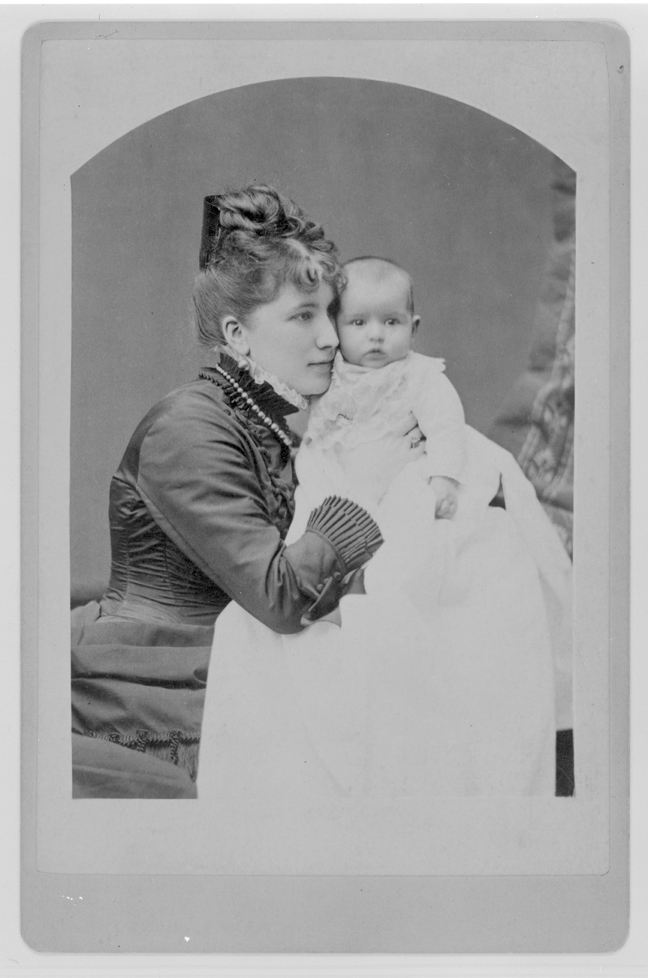


 Esther Campbell Holladay and daughter, Linda Holladay.
  -Courtesy of the Oregon Historical Society, OrHi #100106.

 Ann Holladay died September 18 1873, three months after her visit to San Francisco, at the same time Ben Holladay's fortune was collapsing in a financial panic.  A year later, Ben Holladay and Esther Campbell married.  They had two children together, a son, Ben Campbell Holladay, and a daughter, Linda.  They lived at the house on Third and Stark as Holladay tried unsuccessfully to return to riches.  He died in 1887, Esther died two years later.  They are buried together in Portland's Mt. Calvary cemetery.


 -The Sunday Oregonian, November 20 1921. 

An article in the Sunday Oregonian, written forty-three years after Ben Holladay's death, brings the house at Third and Stark and its surroundings into sharper focus.  It celebrates the eightieth year of Maria Evangeline Campbell Smith, one of Esther's older sisters.  In it she describes her long time home on lot #2 of block #47, on Third Street between Stark and Washington, and her years spent as the organist at the church that neighbored her house to the south.  


 Third and Stark (the present site of Huber's).
 
The article, combined with city directories and other sources provides a view of the house at Third and Stark, not as a high class brothel, but as part of what was essentally a Holladay-Campbell compound.  

Directly behind Holladay's residence lived his brother Joseph, a loyal lieutenant and eventual foe .  The house to left of Holladay's belonged to Maria Campbell Smith and her husband, prominent druggist Samuel Smith. Partially visible is the Presbyterian Church where she was the organist.

To the rear the church, in a house facing Washington, lived Harriet Biddle Campbell, Maria and Esther's mother, likely with their youngest sister, Harriet, who would eventually marry R.H. Towler, Ben Holladay's personal secretary. 

Behind the photographer was the Catholic Cathedral (today, the Bishop's House is a remnant) on the north east corner of Third and Stark, to which Holladay, a Catholic, donated a stained glass window in his and Esther's name.


Even by the extravagant standards of his peers, Holladay's methods and life style stood out.  His brazenness was unforgivable, once his fortunes turned.  He was not to receive
from the Oregonian the relatively free pass granted to the later financial over-extensions of Henry Villard or George B. Markle.  

Joseph Gaston's views, dominant into the age of Wikipedia, provided the fertile ground for Kimbark MacColl's erroneous  interpretation of, if not a scandal, then the wrong scandal.  A closer look at history, and the circumstances of its writing, asks for a more nuanced approach. 


Sunday, February 26, 2012

Mark Twain in Portland


A world tour was not Samuel Clemens's first choice as a way to spend his golden years, but financial misfortune had made one a necessity. His publishing house, Webster and Company, failed in 1894 and his large investments in the Paige Compositor typesetting machine evaporated when the complex apparatus was made obsolete by the Linotype. A series of lecture engagements to span the globe was seen as a way to recoup some of his losses and pay off his creditors. It was under those circumstances that Mark Twain, sixty years old and in poor health, appeared at the Marquam Grand Opera House on Friday, August 9 1895.


He arrived at the nearly completed Union Station from Tacoma that evening with his manager, Major James B. Pond ("Pon" to Twain). His wife, daughter and the rest of his traveling companions had elected to stay behind in Washington. The night was warm, with the smell of smoke from distant forest fires in the air. He was shuttled from the station by coach on 6th Street to the Marquam Grand, where a standing room only crowd waited.


The Marquam Grand (left) where Twain appeared, and the Hotel Portland (right) where he stayed on August 9 1895.


Portlanders had flocked to the city's most opulent venue to see the noted humorist, whose reputation as a speaker nearly exceeded his as an author.


"With rare versatility, Mark Twain not only excels with his pen, but is equally at home on the platform, and captivates his audiences by the dry, droll, almost apathetic manner of which he brings out the wit and humor of his own productions."
-The Oregonian, August 4 1895.


R.W. Mitchell, who had known Twain a quarter century before, wrote the Oregonian on August 7 1895:

"Mark Twain is greater today than he was 25 years ago. His fame is more permanent, and stands more prominently out, now that his fortune is gone. Reading him is good. Hearing him is 50 per cent better. It was the same way with Dickens."


Mark Twain at the Marquam Grand Opera House.
-The Sunday Oregonian, August 11 1895.


Twain took to the stage in front of the "very fashionable and extremely large" audience. His loosely structured monologue featured excerpts from My First Theft, The Jumping Frog of Calaveras County, The Character of the Bluejay, A Fancy Dress Incident, A Bit More than He Could Chew, Tom Sawyer's Crusade, Fighting a Duel in Nevada and A Ghost Story, interspersed with digressions and improvisations. The audience was in high spirits, punctuating Twain's droll delivery with laughter. After an hour and a half, he left the stage, but was called back by the crowd for a rendition of The Stammer's Tale.


"...at its close the lecturer took occasion to thank his hearers for such a cordial reception on a summer evening, and expressed his sincere gratification that his meeting with the public of Portland was of such a substantial and pleasing character."
-The Oregonian, August 10 1895.


The Arlington Club at Alder and West Park, its home from 1892 to 1910.


After the show, Mark Twain and his entourage proceeded two blocks west to the Arlington Club for a dinner hosted by Twain's long time friend, Charles Erskine Scott Wood, where he held court with some two dozen of Portland's Haut Ton set. He then retired to the Portland Hotel.


Portland attorney and author Charles Erskine Scott Wood was a long time friend of Samuel Clemens. In 1882, while assigned to West Point as an aid-decamp to General O.O. Howard, C.E.S. Wood helped facilitate the anonymous publication of Twain's ribald farce "1601". Twain would later write of the work" "if there is a decent word findable in it, it is because I overlooked it".


L.L. Hawkins at the reins, outside the Portland Hotel on June 18 1895, three weeks before Mark Twain departed there for Union Station.
-City of Portland Archives


The following morning, Twain, wearing a blue nautical cap, stood outside the Portland Hotel as his bags were loaded into the coach to take him to Union Station.


"Dozens of people came up to reach over the array of handbags and shake hands with Mark Twain. Most of them claimed to have met him before, and his face wore a rather puzzled look sometimes as he was reminded of the various places and occasions where he had met them in days gone by."
-The Sunday Oregonian, August 11 1895.


When the bags were loaded, Twain, Major Pond and the Oregonian's reporter boarded his coach for Union Station. As they rode down 6th Street he commented to the reporter:

"Portland seems to be a pretty nice town and this is a pretty nice smooth street. Now Portland aught to lay itself out a little and macadamize all the streets like this. Then it aught to own all the bicycles and rent 'em out and so pay for the streets. Pretty good scheme eh? I suppose people would complain about monopoly, but then we have monopolies always with us. Now in European cities, you know, the government runs a whole lot of things, and, runs 'em pretty well. Here many folks seem to be alarmed by government monopolies, but I don't see why. Here cities give away for nothing franchises for car lines, electric plants and things like that. Their generosity is often astounding. The American people take the yoke of private monopoly with philosophical indifference, and I don't see why they should mind a little government monopoly."

The conversation continued about Twain's next book of travel writing.

"It will be a lazy man's book. If anyone picks it up expecting to find full data, historical, topographical, and so forth, he will be disappointed. A lazy man, you know, don't rush around with his note book as soon as he lands on a foreign shore. He simply drifts about, and if anything gets in his way of sufficient interest, it goes into his book."


The newly completed Union Station, circa 1896.

Twain left the coach and entered the temporary station facilities with Major Pond and the reporter from the Oregonian in tow. Noticing the finishing touches being applied to the new depot he inquired:

"There must be some reason why a town like Portland has not long since built a new depot. What is the reason?"


The reporter explained that tow of the railroads serving it had passed into receivership, which delayed construction (a major depot had been planned for Portland since 1883).

Twain concluded his interview in the smoking compartment of the Olympia car. He noted that, in novels, characters are drawn and re-combined from memory:

"We mortals can't create, we can only copy. Some copies are good and some are bad."

He bid farewell as the train prepared to depart.

"Well, I haven't had an opportunity to see much of Portland, because, through the diabolical machinations of Major Pond over there, I am compelled to leave it after but a glimpse. I may never see Portland again, but I liked the glimpse."


Mark Twain at Union Station, from the Sunday Oregonian, August 11 1895.


Twain continued the Northwest leg of his tour with appearances at Olympia, Seattle, Victoria and Vancouver before departing for Australia. He would recall his sojourn in the region in his "lazy man's book" published two years later.

"It was warm work, all the way, and the last fortnight of it was suffocatingly smokey, for in Oregon and British Columbia the forest fires were raging."
-Following the Equator, a Journey Around the World, by Mark Twain.

The world tour was a success and within three years he would be out of debt. Despite his ill health on tour, Mark Twain lived for fifteen years after his Portland appearance.


Lectures, Beer, Bloodsport and Music


Those in Portland not fortunate enough to escape the smoke to Seaside or Long Beach had a variety of activities to choose from the weekend of Mark Twain's visit.

At the regular Free Suffrage meeting the conversation was on the "topic class" presented by Abigail Scott Dunaway to leading society ladies who wanted to be informed on the equal suffrage question.

At Fourth and Morrison, crowds flocked to the new beer hall opened by the Schlitz Brewing Company. The Oregonian wrote: "The beer was delicious and a positive revelation to those who had never been fortunate enough to taste the product of a great brewery." Perhaps in response, admission to the Gambrinus beer garden near 23rd and Washington was free.

Meanwhile, south of town along the Macadam Road at the White House's race track, a bear baiting proved a disappointment to a "party of well known sportsmen" when the two year old black bear, after cuffing about the eleven dogs sent after him, made friends with the pack.

At the other end of the entertainment spectrum, for those wanting to escape the dust of the city, if not the smoke from the forest fires, relief was a cable car ride away to Cable Park, atop Portland Heights, for a concert that featured selections from Verdi and Strauss.

The story of the forgotten park, and the attractions to be found there, will be the subject of the next installment of Cafe Unknown.

Cafe Unknown of Facebook


Original iron work from the fence of the Portland Hotel, restored to its original location at Pioneer Courthouse Square, a few yards from where Mark Twain departed for Union Station.

Thursday, December 29, 2011


The Wil / Wal Controversy


From Cascades frozen gorges
Leaping like a child at play,

Winding, widening through the valley,

Bright Willamette glides away

Onward ever,
Lovely river,

Softly calling to the sea;

Time, that scars us,

Maims and mars us,

Leave no track or trench on thee...


-From Beautiful Willamette, (1868) by Samuel L. Simpson.

When doomed Samuel L. Simpson, Oregon's first poet laureate, wrote Beautiful Willamette, he had a choice as to what form of name to address his muse. A dozen or so variants in spelling and pronunciation, dating from the exploration and early settlement eras, had winnowed down to two leading contenders: Willamette and Wallamet.

In the decade that followed, a protracted public debate ensued, with supporters of each name arguing passionately for legitimacy- "The Wil / Wal Controversy."


The steamboat Wallamet, circa 1854.


The question first appeared in the Oregonian on April 5, 1857, seventeen years before the height of the controversy. The article: Wallamet or Willamette etc etc, noted:

"The orthography of our far-famed valley is curiously unsettled, like a good many other things in a newly settled country. The "University Press," the Statesman, Fremont, the first bound volume of Oregon laws, the pronunciation of the early settlers, following the natives, make it Wallamet. Wilkes, following the Frenchified of some romantic scribblers of the East, has it Willamette."

The Statesman was the Salem newspaper, John Charles Fremont a western explorer, and Charles Wilkes was the leader of the first U.S. Navy expedition to the Pacific Coast.

"We rather think the Wallamets will in the end have it."


Portland in the 1870s.

"Among the fir clad hills and broad rich valleys of Oregon, the bucolic instinct still lingers. Of the 100,000 people who constitute the permanent population of Oregon, fully four fifths of them dwell not in town or village, but upon farms. Yet the commercial metropolis of Oregon, Portland-on-Wallamet is the second town of importance on the Pacific Coast. Next to San Francisco the capital of commerce of the Pacific Slope will center in this solid and respectable Oregon town."

-The Overland Monthly, July 1868.


Judge Matthew P. Deady


The author of the Overland Monthly article was U.S. District Court Judge Matthew P. Deady of Portland, a Wallamet adherent, some would say zealot. That same year he wrote in the San Francisco Bulletin:


"The word is of Indian origin, and as they have no written language the early settlers of this country caught the pronunciation from them and gave it an English orthography."


He noted that it was spelled differently by different people and listed three variants: Wallamet, Whalamet, and Wallamut. As for Willamette, he believed it derived from a mistaken belief the name had its origins with the French Canadian voyageurs employed by the the Hudson's Bay fur company.

By the time of Deady's writings, Willamette was the more common name in use. Evidence of its continued ascent could be found in Wallamet University changing the spelling of its name to Willamette University in 1870.


Judge Jesse Quinn Thornton


In Our River and Its Name (the Oregonian on March 11 1870), Jesse Quinn Thornton, a former Territorial Supreme Court Justice, wrote:


"...there does not appear to be, even among educated persons, any uniformity as to the method of spelling the name of the valley, which is by far the richest and most interesting portion of our state."

He came down on the side of Wallamet:

"The word itself is of Indian origin, purely aboriginal"
and referred to the "miscalled Willamette University," a sentiment he expanded upon in a second piece on April 20 1870:

"It ought not be forgotten that this University was built up by the early missionaries, upon the foundation of an Indian mission school; and that the same missionaries procured for it a charter, designating it as Wallamet University- not the affected and fanciful French name of Willamette University.


Judge William Strong

Thornton's letter was met with a rebuttal by William Strong, a fellow retired Territorial Supreme Court justice, who advocated for Willamette in the Daily Herald, March 13, 1870.

Strong doubted the name had a Native American origin. If it did, he thought it unlikely used for the entire river. He cited the journals of the Lewis and Clark Expedition which referred to the river below the falls as the Multnomah.

He believed the word had French roots, referencing a letter from George Simpson of the Hudson's Bay Company to the Bishop of Quebec in 1838.

He also related a "charming legend" of three French boys named Guilliam (William), who once lived along the river; thus the Guillamette (little Guilliam's) River, anglicized to Willamette.


The Wallamat, or Multnomah River flows deep into the eastern reaches of the Oregon Country in this 1825 map. Multnomah is from the Chinook word for downriver: nematlnomaq.


The Wil / Wal Controversy began in earnest with the publication of the State Code in September 1874 which adhered, as all prior ones had, to the Wallamet name. Complaints on its usage in the Oregon legislature prompted Judge Deady to write The True Name of Our Beautiful River in the Oregonian, October 15 1874.

Again, he pronounced a possible French origin of the name as in error:

"The use of Wallamet can be traced back to the early part of this century when the country first became known to white people. It is an Indian word, and the true and original name of the river, while Willamette is an ignorant and anonymous fabrication or a modern corruption of the former."

He cited numerous early sources in support of Wallamet and its variants, including Dr. John McLoughlin (in documents from 1844) and Alexander Ross (reminiscences on his arrival in 1811, published in 1840). Deady concluded:

"...admitting that no one is bound by authority in this matter and that we are at liberty to adopt whatever name we may fancy, we should chose the old name by all means. As between it and the modern, spurious one, there is no comparison in point of strength, dignity or euphony. Willamette has a thin, close, meagre sound, and a petty, foppish appearance, while the broad, full sounding Wallamet is every way worthy of the incomparable and beautiful river shall yet be known as the paradise of the Pacific."


Archbishop of Oregon, Francis Norbert Blanchet


Archbishop Francis Norbert Blanchet had written on the subject as "An Old Pioneer" in 1870. He returned to it under his own name and title in a letter to Governor L.F. Grover, published in the Oregonian, October 7 1874.

He recalled that upon his arrival in the Oregon Country in 1838, Wallamette was the only name used for the river and that Willamette came into broad use some time after 1850. The loss of the final te from Wallamet was "warranted by no tradition or authority whatsoever." As for Willamette, it was a "change or mutation" that was allowed to spread unchecked by early settlers. He ended with:

"Is there still any chance for restoring to our river, and its valley, this old and time honored name? If there be, please make use of the present to obtain it."


The Willamette River flows through Portland in 1852.


Judge William Strong returned to the fray, with a defense of Willamette and an attack on Judge Deady, in the Daily Bulletin, October 22 1874:

"When a new code is prepared by the Judge (Deady), it produces a newspaper controversy upon this subject, which seems to establish the strong presumption that the name Wallamet is not and never will be accepted by the people. This may be the reason why he persists in his effort to change the name. He seems to have a mania for reform of a sensational character."

The word had "no marks of an Indian word, no guttural or sibilant sounds- which abound in Indian languages." Its termination was "indicative to a French Canadian origin." Even if there had been a change to Willamette in the 1840s, it was at:

"...about the time when we first began to have authentic accounts of the river from educated and intelligent persons; and if such a change did take place at the time it was the result of American settlement, and a change from barbarism to civilization."

After an exhaustive list of Willamette precedents, he concluded:

"The name is too well fixed in the public mind now to be changed, even it were objectionable in point of taste. But I contend that Willamette is as much better taste than Wallamet as Mississippi and Virginia are in better taste than Mass-a-sap and Varginny."


Francis Fuller Victor

Francis Fuller Victor, author of The River of the West: The Adventures of Joe Meek, and numerous later works of Oregon history, was drawn into the controversy after being miss-quoted by Judge Strong. She wrote:

"From my first entrance into Oregon, about ten years ago, I have been an interested and industrious student of everything relating to the country, and among other things, what research could be made into the subject of Indian names, both for the sake of the subject itself, and in greater measure for the sake of accuracy in writing it. My researches led me to the following conclusions:

First, that the Indians never gave names to rivers as a whole, but instead used descriptive words in speaking of certain localities; hence that, on this plan, every river had various names, according as it was rapid, or deep, or clear, or stained, or had a fertile or barren shore etc..."

Citing the word whah meant to spill, or pour, in Native languages west of the Cascades, she found it likely that Whalla-mut referred to either the falls at Oregon City, or the place where the river flowed into the Columbia, or the region between both points.


"After careful consideration, I adopted the "Wallamet" spelling as retaining the sound of the original word, and at the same time deferring to an English notion of orthography, since all our Indian words are more or less anglicized."


Joseph Gale, writing from Eagle Creek, had come to similar conclusions on Native usage of the word:

"The Indians have more poetic talent than we are aware of, and this word is used by them as an adjective to describe the river, not as a noun merely to name it."


E.W.Reynolds sides with his Democratic friend, Judge William Strong.
-The Oregonian, November 12 1874.


The controversy drew letters and readers to Portland newspapers. More than just a scholarly parlor game among the learned, it reflected social and political divisions, such as when James O'Meara, editor of Ben Holladay's paper, the Daily Bulletin, needed distance from Judge Deady for political reasons and opted to change his stance on Will / Wall to allow a sundering that concealed his true motives.

Readers lined up behind Judge Strong or Judge Deady. The exchange became heated. Strong lampooned Deady as "the only gentleman who hailed from Portland-on-Wallamet." Deady fired back at Strong's "silly little legend of the three French Willies." Strong had "committed gross and unpardonable error." Deady was "so very particular to criticize small mistakes, even those which can have no real bearing upon the real merits of the question." Strong had "fallen into pleasant delusion" and "relied upon his imagination for facts." Deady had a "mania" on the issue (Strong might have had him there).


"Judge Strong is a volunteer in this controversy, and it is his duty to inform himself before he undertakes to teach others." -The Oregonian, from Judge Deady's Reply to Judge Strong's Second Letter, November 20 1874.


To vitriol was added virtuosity as each side piled precedent upon precedent to make their case. Explorers accounts, linguistic tracts, pioneer reminiscences, maps, old deeds, receipts and legal transcripts were produced and duly cataloged as arguments continued into 1875.

After the controversy had played out, it was generally thought Wallamet was proved to be the older name and that it had Native American origins, but Willamette was by far more prevalent and accepted, a dissonance that prompted William Lair Hill, in the Oregonian, March 6 1875, to opine:

"But since Wil-lamette has become the more frequent form, in usage, would it not be well to accept the change? That is a question on which people may differ. Those who think it is desirable to preserve the original names of places and prominent physical objects in the country will take the negative; those who do not think so will take the affirmative."

The controversy generated so much interest that thirteen of the most noted letters from 1874-75, along with five from the initial skirmish of 1870, were gathered by George Himes in Wallamet or Willamette, a sixty six page book published in May 1875.


On June 1st 1876, six years after Willamette University changed from Wallamet University, the school reverted to its original name for a day when Judge Matthew Deady addressed its graduating class.


The final volley in the exchange took place nearly a quarter century later. On November 25 1895, two years after Deady's death and eight after Strong's, the Oregonian published Wallamet, A Post Script to an Old Controversy by Richard Hopwood Thornton, which drew attention to Captain Nathaniel Portlock's Voyage Around the World (1789) as the earliest source of the word in print. Portlock described seeing daggers purchased by the Indians of Puget Sound at "Wallamute."

The book, a copy of which was in the Portland Library, had miraculously escaped detection during the controversy (today it resides in the John Wilson Special Collections room at the Multnomah County library).


The revelation did not revive the debate, which was itself was receding into history. Wallamet was becoming a quaint anachronism, while Willamette, certainly by the publication of Lewis A. McArthur's Oregon Geographic Names in 1928, had achieved the status (apologies to Judge Deady) of stare decisis.


This post is dedicated to John Terry, member of the Oregon Geographic Names board and author of the Oregon Trails column in the Oregonian, which was sadly discontinued last Sunday. The column has been a favorite of mine for years. It did much to develop my belief that history is not something that just happens somewhere else. Thanks John!

-Dan Haneckow, Portland-on-Wallamet, December 29 2011.

(...the surname is of eastern German origin. The c was mysteriously added in America, decades after its arrival. The name ends with a long o sound, along the lines of Paltrow).

Cafe Unknown on facebook


Link


Thursday, October 27, 2011


The Sculpture Beneath 4th Avenue


"Times change- This might not be right." So wrote the map's prior owner in the margins under item #23, an entry that purported the existence of a "Underground Sculpture."


Downtown Portland A Walking Tour Map with Guide to Points of Interest was issued, complements of Lipman's department store and First National Bank of Oregon, some time between the dedication of O'Bryant Square in December 1973 (item #32 "One of the newest additions to downtown's collections of parks...") and the opening of the Galleria (absent on the map) in 1976.


It provides of a glimpse of a watershed moment, when the Downtown Plan of 1972 began to produce tangible results, and of a Portland both familiar and alien. Benson Bubblers, the Dekum and Commonwealth buildings, Portland Art Museum, the Pioneer Courthouse and City Hall are highlighted, as well as landmarks of today with different names: Chown Electric (Kell's) the First National Bank Tower (Wells Fargo) and the Forecourt Fountain (Keller).


Backwaters are brought to forefront: The Portland Center (item #1) and Lovejoy Fountain (item #2). Some entrees, such as the Equitable Center (Unitus Plaza today) and Morgan's Alley remain, their prominence forgotten. Others are gone (the Yamhill Market), some practically from memory (the Mowhawk Galleries and Annex on the block bounded by SW 2nd, 3rd, Yamhill and Morrison).


Among the latter, I consigned the "Underground Sculpture." Surely it could not still be in place, unremarked, today. But what was its story? Where was it now?


The Georgia Pacific building under construction, on the block bounded by SW Salmon, Taylor, 4th and 5th, in 1968.
-Marion Dean Ross Photograph, University of Oregon Libraries, Building Oregon collection.


The eight foot tall sculpture of pressed formed and chrome-plated steel, by Oregon artist Bruce West, was installed in its subterranean home in August 1973, five years after the completion of the Georgia Pacific building. Its last mention in the Oregonian was on February 1st 1981, from a walking tour for for families titled Making the City Your Playground. A year later, Georgia Pacific moved its corporate headquarters to Atlanta Georgia.

Beyond that time, I could not find reference of it anywhere.


I checked a Google Maps satellite view. There was a parking garage across 4th from the Georgia Pacific building, today known as the Standard Insurance Center, but it looked of more recent vintage than its towering neighbor. Did it replace an older structure? If so, had the connecting tunnel been filled in?

Alternate narratives formed in my mind. Did Georgia Pacific take the sculpture with them when they moved to Atlanta? Was it donated to the Portland Art Museum? Perhaps it sat in the lobby of the Standard Insurance Center, or in someones sculpture garden.

There was a way to find out.

I went to the parking garage at SW 4th and Salmon. I Followed the map's instructions and walked to the elevator. There was indeed a "C" level. I pressed the button and descended. The doors opened into a florescent lit corridor. I turned right and started walking. A short distance later the floor angled downward.


It stood facing between mirrors that created an infinity of gleaming silver sculptures. I was the only person there. The silence fostered an illusion of stopped time. Unlike an outdoor sculpture it had acquired no patina with age, it was pristine. It was still August 1973, art for automobile commuters, two months before the Oil Embargo.

I noticed how the mirrors opened up a space which otherwise would be too small for the piece's scale. I thought about the traffic on 4th Avenue passing unheard above my head, and of Richard Nixon. It had been there all along. It seemed so unlikely.

Times change. The sculpture had not.


Downtown Portland without Max, the Bus Mall or Pioneer Courthouse Square but with Front Avenue and Fareless Square.

Cafe Unknown of facebook
@DanHaneckow on Twitter

Wednesday, October 05, 2011

Half Life


A visit to Old Portland Hardware and Architectural on SE 41st and Division is a chance to view the unexpected re-emergence of a cache from one of Portland's vanished architectural treasures; the Ladd Block (1881) knocked down in a storm of controversy in 1965. The story of its demolition and the dispersal of its pieces is one of reverence and disregard, back and forth, played out over the course of a half century.


"Among the edifices particularly worthy of mention are: The three story brick building on the northwest corner of First and Columbia, for Mr. W.S. Ladd. Special pains were taken by the architect, Mr. Justus Krumbein, to make the building equal if not superior in point of strength to any in the city." -The Oregonian, January 1 1882.


The Ladd Block, drawing by, and courtesy of William Hawkins III.

William Sargent Ladd's excursion into what is now called mixed use development was on Columbia, five blocks east of his mansion, and First, nine blocks south of his Ladd & Tilton Bank. On the ground level was space for four retail stores. The second floor held four large residences, laid out in the "French flat" system, each with two bedrooms, a parlor, dining room, kitchen, pantry, bathroom, closets and a separate staircase and exit. The top floor was divided into single rooms and suites for hotel purposes. The exterior was styled "modern Gothic" with cast-iron and tin architectural details and a menagerie of wolves, lions and bears standing watch on the upper levels. Sturdy, state of the art and fireproof, the Oregonian anticipated that it would still be standing when Portland's population reached five hundred thousand people.

In 1891, a hotel, the Ladd House, operated on the upper floors, offering furnished rooms for five dollars a piece and housekeeping rooms for three. In a possible reflection of First street's change in status over the prior decade as downtown moved west, its proprietor, Mary E. Baker, was accused of operating a brothel there in 1895. The hotel closed soon after.


"The Ladd House has the reputation of being a "graft house," a rendezvous for petty thieves and criminal of the lowest type, and particularly as an abiding place for slaves of morphine, cocaine and opium. Worse still, the officers say, that women of the lowest type resort there with male outcasts of society, and together they hold orgies that beggar description." -The Oregonian, April 6 1895.


A second hotel, the Villa House, opened on the premises a decade later. Its proprietor, Andrew C. Wald, was succeeded in 1914 by Tojiro Haji, the first of four Japanese-American hoteliers, followed by F.M. Isoshima (1920 to 1926), George K. Kawaguchi (1926 to 1930) and H.K. Uyesugi (1930 to 1942). There is likely a significance to the year of his departure.

Over the years various business occupied the store fronts on the ground floor, such as Sam Margulies's Saloon (circa 1911), Victors Cash Grocery (circa 1916) and the American Chili Parlors (circa 1928). In the 1950s a second hand store occupied the corner storefront at First and Columbia.


The Ladd Block in the 1950s
. -Marion Dean Ross photo, Building Oregon Collection, University of Oregon.


Detail of above, of the second hand store on First and Columbia. On the once ubiquitous second hand business in the old downtown, Sam Raddon Jr. in the 1946 book Portland Vignettes, wrote: "There is color and atmosphere still, in the district that has seen better times, where the shop-keeper and his friend may sit in the shade of a summer afternoon, and talk of the affairs that effect their own little world. Where business comes from no one pretends to know. But year in and year out the routine goes on. The dust of a generation may seem to have accumulated on stock and trade, but occasionally, at least someone must sell, and someone else must buy."


The Villa House closed in 1963. For the next two years the building, owned by the Boyd Coffee Company, sat vacant. The stage was set for one of Portland's most notorious episodes of historic desecration.


Drawing in the Oregonian, February 20 1965.


On February 19 1965 the Portland Development Commission released an "area guide plan" for the blocks bounded by SW Front, 4th, Market and Salmon, immediately north of the South Auditorium Urban Renewal project. Unlike the scorched earth approach pursued with South Auditorium, which stripped the district even of its street grid, the "guide plan" proposed some rehabilitation in the existing neighborhood. Specifically cited for renovation were the "ancient iron front buildings" the Ladd and Monastes Blocks, on the west side of First, between Columbia and Jefferson.

The PDC's suggestion spurred the Boyd Coffee Company, whose office and plant bordered the buildings to the west, to contract with the Western Wrecking Company, to quickly demolish the structures.


"Fearing harassment by city agencies, or by concerned citizens, the owners of Boyd Coffee Company, who wanted to make room for a new warehouse, opted for the "midnight disappearance" strategy of demolition. Almost overnight, the half block Ladd building became a paved parking lot." -The Grand Era of Cast-Iron Architecture in Portland Oregon by William Hawkins III.


In response to the public outcry over the demolition, Mrs. V.B. Younger, secretary-treasurer of the Boyd Coffee Company, stated the city had ordered the buildings be bought up to code or demolished. Architects had been consulted and the cost to remodel the buildings was found to be prohibitive. She noted that the drawing (above) that had appeared in the Oregonian was for dramatic example, not to be taken literally.

"There is no condemnation order against the buildings." -Portland Mayor Terry Shrunk in the Oregonian, March 12 1965.

"I resent the fact that the owner appears to passing the onus to the city, by claiming he was ordered to raise the buildings." -Francis J. Murnane, Portland Art Commission in the Oregonian, March 12 1965.


Wolf head ornament from the upper level of the Ladd Block, donated to the Architectural Heritage Center by Christopher Boyd.


The long half life of the Ladd Block began when Bob Hazen, President of the Benj. Franklin Savings and Loan, was walking by the demolition site when he noted its metal pieces. With no particular use in mind, he asked a workman if he could purchase some of them. A price of three thousand dollars was agreed upon. They were removed to a warehouse for storage.

Ten years later, a use for the pieces was found when the Benj. Franklin Savings and Loan purchased a newly completed office tower, across the street on First from the site of the Ladd Block, for its corporate headquarters. On the top floor Bob Hazen outfitted a luxurious executive suite that utilized the Ladd Block's fixtures.

To create his 19th century haven on the 19th floor, Hazen consulted with Portland preservationist Eric Ladd to create a most unlikely office space, complete with a stained glass ceiling from the Washington Hotel, made surplus after most of its lobby was converted into courtyard, and a stairwell mural of the Ladd Block by William Hawkins (from the drawing at the beginning of this post). Decorative tin and ironwork were re-purposed as book cases to surprisingly good effect. A statue of Benjamin Franklin, and a receptionist dressed as Dolly Madison completed the eclectic, if somewhat surreal, scene.


The 19th Floor, with ceiling from the Washington Hotel and a column from the Ladd Block.


Two years later, in 1977, a column from the Ladd Block, from the Portland's Friends of Cast Iron Architecture's collection, was mounted in the new pedestrian arcade at Ankeny Square which showcased the area's cast iron heritage.


When the Benj. Franklin closed in 1990 Bob Hazen's office suite was dismantled with the pieces donated to the Bosco-Milligan Foundation. Some can be seen today in the Architectural Heritage Center's Rebuilding South Portland exhibit.


Ladd Block piece at the Architectural Heritage Center.


The recently removed courtyard installation in the former Benj. Franklin Plaza. Sadly, the whereabouts of the lions are unknown.


Until recently there were remnants of Bob Hazen's cast-iron confection, nearly forgotten, in the 19th floor courtyard and lobby of the building now known at the Umpqua Bank Plaza. It is those pieces that have appeared at Old Portland Hardware after being removed in a recent remodel. Upon being contacted by the project's architect, Bret Hodgert and Scott at Old Portland had very little time to wheel the fixtures, some weighing hundreds of pounds, downstairs to a loading dock, which happily was higher than their flat bed truck.

"When I was a kid, I wanted nothing more to be that archeologist in National Geographic. It was kind of like that." -Bret Hodgert of Old Portland Hardware, on obtaining the Ladd Block pieces from the remodel site.


Bear from the Ladd Block at Old Portland Hardware and Architectural.

For a short time the Ladd Block pieces can be seen in three places: the Architectural Heritage Center, Ankeny Square and Old Portland Hardware. Save for those at AHC their long term status is in flux, as the Old Portland pieces are for sale, and a possible revamp of Ankeny Square, mentioned in 2009, which might replace the current installation with a new twelve columned structure.


Signage at Ankeny Square, this one describing the Ladd Block has deteriorated badly.


A fence, later added to protect the Fire Fighters exhibit, effectively cut the cast-iron display in half.


The situation at Ankeny Square symbolizes Portland's relationship with its past, the seesawing between veneration and neglect, with no way to predict the next swing. Will the revamp, which might include restrooms and a information kiosk ever take place? Will the existing cast iron on the wall be removed to storage after the new arcade, essentially a zero sum game, or will the be refurbished (and hopefully repainted in something other that the odd choice of back)? What of the rest of the trove of cast-iron, owned by the PDC, that is stored under a bridge? Forty-six years after after the loss of one of the last major cast-iron building to be demolished, the questions remain on how to best re-purpose Portland's iron age remnants.


Proposed Ankeny Square revamp. Perhaps a return to Vine Street? -The Portland
Mercury.


First and Columbia, site of the Ladd Block, one of the few surface parking lots lost to new construction.


The Ladd and Monastes Blocks, looking north on First from Columbia in the 1950s. -Marion Dean Ross photo, Building Oregon Collection, University of Oregon.


Cafe Unknown on Facebook.


High Water!


On Monday, October 17 at the Mission Theater at 7:00pm I will be presenting High Water; Portland and the Flood of 1894 for the Oregon Encyclopedia's History Night.

From the press release:

On May 27, 1894, the rising Willamette River began to flow into the streets of Portland. For one month, Portland, already reeling from the financial crash of 1893, was inundated by floodwaters. City life came to a halt, then adapted with flotillas of small boats for shopping and spindly bridges that spanned between second floors. Fire engines were towed through the streets on barges, and the bars moved onto rafts. The receding water left the city a hellish, stinking mess.

Dan Haneckow explores Portland of the 1890s and its watery ordeal with stunning images of the "Metropolis of the Northwest" as it dealt with one of its greatest challenges.

Hope to see you there!